
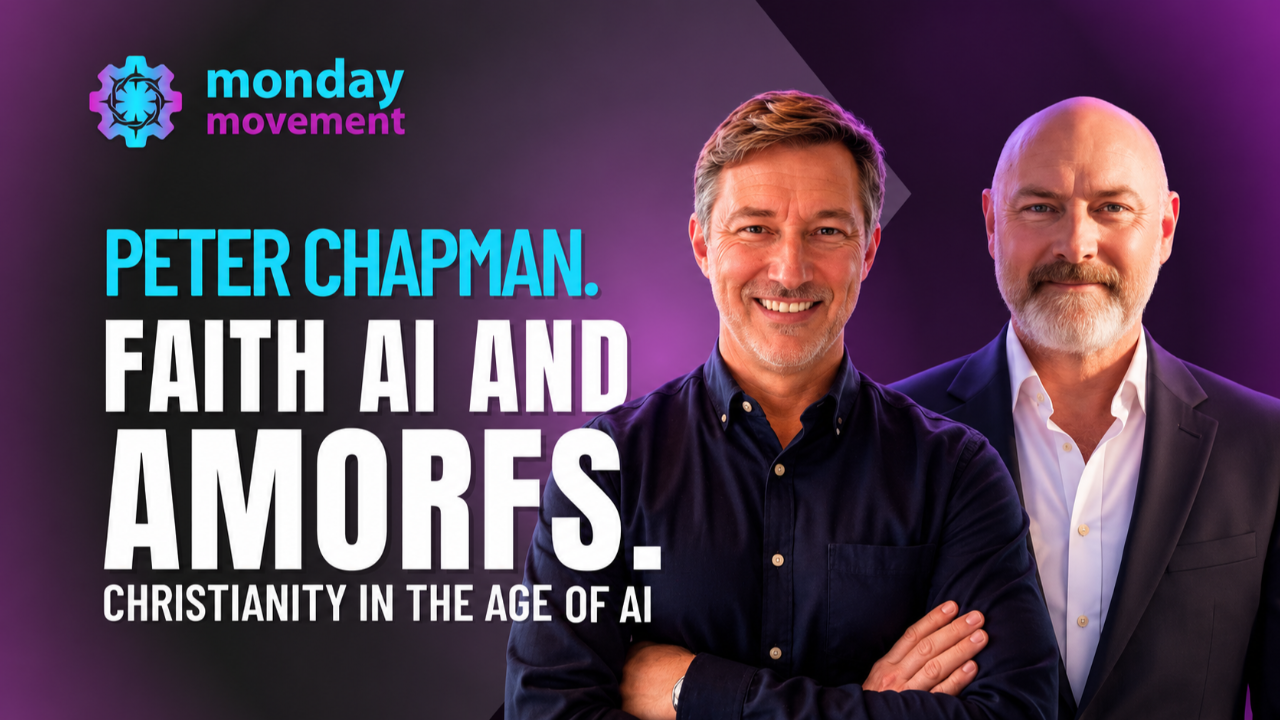
Peter Chapman, Faith, AI and Amorfs | Christianity in the Age of AI
AI is becoming part of ordinary work very quickly.
We use it to help us write, search, organise information, solve problems and make sense of large amounts of data. For many leaders, the first question is practical: What can AI do for us?
But I think there is a more important question.
What is shaping the AI we are asking to help us?
Artificial intelligence can process an extraordinary amount of information. But intelligence alone does not decide what is true, what matters, what should be prioritised or what a good outcome looks like.
Those questions bring us into the territory of knowledge, values, judgement and worldview.
That is what made my recent conversation with Peter Chapman so interesting.
Peter is the Founder of First Cognition and creator of Amorfs. He is an Enterprise AI Architect with more than forty years of international consulting and complex systems experience. His interest in computers began when he was young, long before artificial intelligence became part of everyday conversation. Today, he sees that long professional journey as part of a calling God placed on his life.
Our conversation was not really about whether AI is good or bad. That question is too simple.
We explored something deeper: the knowledge behind AI, the values that shape it, what remains uniquely human, and whether Christians should stand back from this technological shift or help shape it wisely.
Prefer to listen?
1. Intelligence is powerful, but knowledge and values still matter
We tend to assume that more intelligence leads to better decisions.
Anyone who has spent time in leadership knows that is not necessarily true.
You can have very smart people around a boardroom table and still make the wrong decision if the information is incomplete, the assumptions are flawed or the wrong things are being valued.
Peter believes something similar applies to AI.
He explained that one of the problems with current artificial intelligence is that we often give it fragments of information and ask it to put those pieces together, reason about them and give us an answer.
That can produce remarkable results. But when details are complex, when time matters, or when similar pieces of information are connected in different ways, the result can become less reliable.
This is the problem Peter is exploring through Amorfs.
In simple terms, Amorfs aims to package knowledge in a more structured and fact-based way. Instead of giving AI disconnected pieces and asking it to work everything out, the information contains more of the context around it, including how things relate, when they happened and what they mean.
You do not need to understand AI architecture to see the leadership lesson.
Better decisions depend on more than brainpower. They depend on good information and sound judgement.
But Peter takes the argument one step further.
Knowledge also carries priorities.
Some information is treated as important. Other information is not. Someone decides what deserves attention. Someone decides what a desirable outcome looks like.
That means the conversation about AI and Christianity eventually becomes a conversation about worldview.
If two people have access to the same facts but value completely different things, they may arrive at very different conclusions.
The same issue matters when we build or use intelligent systems.
So perhaps the challenge of AI is not only, “How intelligent can we make it?”
We also need to ask, “What knowledge, assumptions and values are guiding that intelligence?”
2. Christians should engage AI, not simply retreat from it
Christians can respond to emerging technology in very different ways.
Some embrace every new development with excitement. Others see the risks and would rather have nothing to do with it.
I do not think either extreme is particularly helpful.
Peter made the point that technological change does not stop simply because we are uncomfortable with it. AI is already here. It is already being used in businesses, homes and organisations.
That means someone will shape how it develops.
Someone will decide which information matters. Someone will establish boundaries. Someone will bring assumptions about truth, ethics, responsibility and what is good for people.
If Christians believe we have something worthwhile to contribute to those questions, withdrawing from the conversation seems an odd response.
Peter used the example of the printing press.
The technology could be used to print the Bible, but it could also print things that had nothing to do with honouring God. The possibility of misuse did not make the technology itself worthless.
The same principle can help us think about artificial intelligence.
Engagement does not mean uncritical acceptance.
Christians should be able to ask hard questions about technology while still being willing to work in the industries, organisations and professions where those questions are being answered.
For Christian leaders, that means becoming thoughtful enough about AI to lead responsibly.
We should be asking:
Where does this system get its information?
What assumptions sit behind its recommendations?
Who is accountable when it gets something wrong?
Where should human judgement remain?
How will this affect employees, customers and communities?
And perhaps one of the biggest questions: Who decides what values the technology reflects?
Peter believes Christians have an opportunity to bring wisdom and an ethical framework into this conversation.
That requires more than criticism from a distance.
It requires people who understand their field, do excellent work, think carefully and are prepared to stay in difficult conversations.
There is a wider leadership principle here.
You cannot influence a conversation you refuse to enter.
If Christian leaders want to contribute to the future of business, technology and culture, we need people willing to be present where that future is being built.
3. Your work may be closer to your calling than you think
Peter’s own story adds another layer to the conversation.
He remembers seeing his first computer when he was 11 years old. He taught himself to code and was already writing programs as a teenager.
Later, he studied cognitive science and artificial intelligence before spending decades working in large organisations and complex technology environments.
But there was one idea that kept returning.
Peter had long wanted to approach data differently. He carried that interest through different roles and seasons of his career, even at times when the technology was not yet ready to do what he imagined.
He describes that thread through his working life as a divine calling.
Now, more than forty years later, developments in AI are allowing him to work on ideas he once wondered whether he would ever see become possible.
I think there is something useful in that for anyone who has ever wondered whether God is genuinely interested in their work.
Calling is not always a dramatic moment where everything suddenly becomes clear.
Sometimes it is an ability you keep developing.
Sometimes it is a problem you keep wanting to solve.
Sometimes it is an area of responsibility that keeps drawing you back.
And sometimes the preparation takes decades.
This is central to what we talk about at Monday Movement.
Faith and work should not live in separate boxes.
Your faith does not disappear when you enter the office, open your laptop or walk into a board meeting.
Peter talked about seeing his work in the marketplace as ministry. But that does not mean turning every workplace conversation into a sermon.
Often it looks much more ordinary.
Work with excellence.
Act with integrity.
Serve the people around you.
Use your expertise responsibly.
Build trust.
Pay attention to the opportunities in front of you.
Peter reflected on conversations with colleagues that sometimes seemed small at the time but stayed with people for years.
We do not always know what impact our work, character or conversations will have.
That is also why visible results cannot be our only measure of success.
Business leaders should care about results. They matter.
But Christian leadership asks another question as well:
Am I being faithful with the skills, responsibilities and influence I have been given?
Near the end of the conversation, Peter returned to the words of Jesus about seeking first God’s kingdom and His righteousness.
For someone wrestling with vocation, that is a useful anchor.
We can spend enormous energy asking whether our career is impressive enough, successful enough or significant enough.
Perhaps the better question is whether we are seeking God first in the work that is already ours to do.
What this means for Christian leaders
Do not outsource your judgement to AI. AI can help us gather information, organise ideas and see patterns. But leadership still carries responsibility. A machine cannot take accountability for the consequences of your decision.
Pay attention to what goes in, not only what comes out. A polished answer can still be built on incomplete information or poor assumptions. Good leaders examine the source, context and values behind a recommendation.
Learn enough to lead responsibly. You do not need to become an AI engineer. But if AI is influencing your people, customers, strategy or decisions, you should understand enough to ask sensible questions.
Do not leave difficult spaces simply because they are difficult. Technology, business and culture need thoughtful people with wisdom and character. Christians should be prepared to contribute rather than only criticise.
Bring faith into the work you already have. Calling does not always require a new job. Excellence, integrity, service and responsible influence are practical expressions of Christian faith in ordinary work.
Think long term. Peter’s story did not unfold in two years. It stretched across decades. The ability, experience or idea you are developing today may prepare you for something you cannot yet see.
Faith should shape Monday as much as Sunday
The question facing Christian leaders is not simply whether we will use artificial intelligence.
Most of us already will.
The deeper questions are about how we use it, what we trust it with and which values continue to guide our judgement.
Will convenience replace responsibility?
Will speed replace wisdom?
Will we assume that because a system sounds confident, it must be correct?
Or will we remain thoughtful about the knowledge, people and values behind the technology?
This is where faith and AI become part of the same conversation.
If technology is shaping the way we work, lead and make decisions, then Christian faith has something to say about how we use it.
That is the heart of Monday Movement.
Faith should shape Monday as much as Sunday.
It should affect the way we lead people, build companies, use technology, make decisions and carry responsibility.
Peter Chapman’s story is a good example of what that can look like. Deep technical expertise, decades of professional work and a Christian sense of calling do not need to compete with one another.
They can belong to the same life.
So as AI becomes more capable, perhaps the most important question is not simply how intelligent our machines become.
What knowledge, values and human judgement are we choosing to put behind that intelligence?
Faith, AI and Christian Leadership: Common Questions
Should Christians use artificial intelligence?
There is no need to choose between blindly accepting AI and rejecting it altogether. A more responsible approach is to understand what the technology can do, recognise its limits and think carefully about how it is used. Peter encourages Christians to remain engaged, particularly where questions of ethics, knowledge and human responsibility are involved. The aim is not enthusiasm for technology itself, but wise and responsible participation.
What does Christianity have to contribute to AI ethics?
AI ethics quickly leads to deeper questions. What do we value? What is good for people? Who carries responsibility? How do we decide what should matter most? Christian thought has long wrestled with questions of truth, wisdom, responsibility, service and human value. Peter believes Christians should be willing to bring that thinking into the technology conversation rather than assuming faith belongs outside it.
Can technology be part of a Christian calling?
For Peter Chapman, the answer is clearly yes. His interest in computing and data began early and developed across more than forty years of professional work. He now sees that journey as part of his calling. More broadly, Christian vocation can be expressed through technology, business and many other professions when we approach our work with excellence, integrity, service and faithfulness.
About Peter Chapman
Peter Chapman is the Founder of First Cognition and creator of Amorfs. An Enterprise AI Architect with more than forty years of international consulting and complex systems experience, Peter has spent his career working across technology, data and enterprise systems. He is also a committed Christian who sees his professional journey as part of his divine calling and believes Christians have an important contribution to make to conversations about AI, knowledge, ethics and human values.
Connect with Peter Chapman on LinkedIn
About Monday Movement
Monday Movement is a faith-and-work platform helping Christian leaders make Monday as purposeful as Sunday. We explore how Christian faith applies to business, leadership, careers, relationships, technology and the everyday decisions that shape our working lives. The aim is practical: helping Christians lead, work and use their influence in a way that genuinely reflects what they believe.
About Mark Bilton
Mark Bilton is the Founder of Monday Movement, author of four books on faith and work, and host of the Monday Movement Vodcast. He spent twenty years as CEO of six companies, including serving as Group Managing Director of Gloria Jean’s Coffees across forty countries, followed by a decade working as an Independent Chair, strategist and facilitator to founder-led businesses. His perspective on faith and work comes from decades inside real businesses, leadership pressure and difficult decisions.
